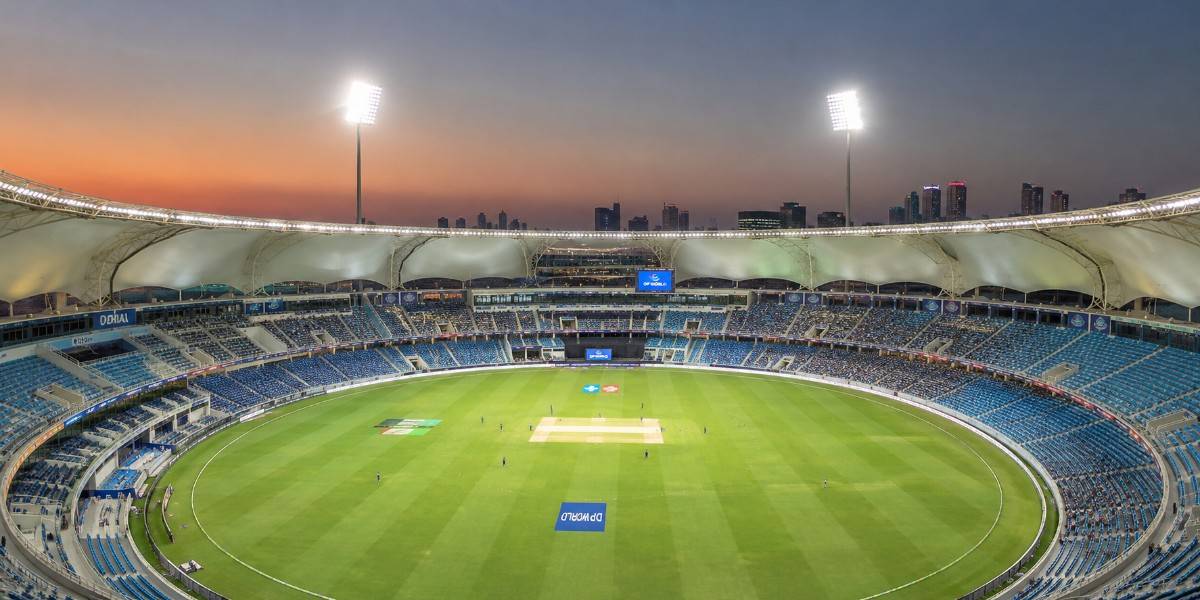
Dubai International Stadium has become one of cricket’s busiest neutral venues. The ground is part of Dubai Sports City, carries a 25,000-seat capacity, and is known in records by its earlier name, Dubai Sports City Cricket Stadium.
For readers searching the Dubai International Cricket Stadium story, the key point is simple. This venue is not remembered through crowd size alone. It is remembered through night cricket, multi-team events, India matches at neutral venues, and a pitch that makes batters work harder once the ball loses pace.
Venue Snapshot Before the Records
| Detail | Current information |
| Ground name | Dubai International Stadium |
| Known earlier as | Dubai Sports City Cricket Stadium |
| City | Dubai, United Arab Emirates |
| Capacity | 25,000 |
| Pitch diameter | 148m |
| Ends | Emirates Road End and Dubai Sports City End |
| Home team listing | United Arab Emirates |
| Time zone | UTC +04:00 |
These Dubai International Stadium capacity details matter because the venue is compact enough for a strong night-match atmosphere, yet large enough for global tournaments, franchise cricket, and high-demand India fixtures.
The pitch diameter should not be read as a fixed boundary length for every match. Rope placement can move for tournaments, broadcast needs, and safety zones. For cricket readers, the number is useful because it explains why the arena feels wide without becoming an enormous bowl. Captains still judge boundaries after inspection, not from venue fact sheets alone. This distinction is important for readers comparing old highlights with match graphics. Each tournament can set ropes slightly differently.
Why the Ground Became a Neutral Cricket Hub
Dubai’s rise came from location, facilities, and reliable event control. The ground gave boards a stable option when matches needed neutral conditions, tight security, broadcast support, and quick travel links.
Pakistan used UAE venues heavily for home fixtures during a long period away from regular international cricket at home. Dubai then grew into a trusted stop for ICC events, Pakistan Super League fixtures, Indian Premier League matches, and Asia Cup cricket.
The venue also suits tournament scheduling. Teams can train nearby, broadcasters can operate from established media spaces, and evening matches work well for South Asian television audiences.
Records That Define the Playing Field
Current Dubai cricket stadium records show 13 Tests, 66 ODIs, and 126 T20 matches listed on the venue profile. The numbers make Dubai one of the most active modern cricket grounds outside traditional Test nations.
Key venue records include:
- Test highest total: Pakistan 579 for 3 against West Indies.
- ODI highest total: England 355 for 5 against Pakistan.
- T20 highest total: India 212 for 2 against Afghanistan.
- ODI lowest total: UAE 49 all out against USA.
- T20 highest chase: Sri Lanka 184 for 8 against Bangladesh.
These records show a ground where large scores are possible, but collapse risk remains real when batters misread pace, grip, and length.
Format Pattern Across Innings
The venue numbers show how differently each format plays. Test cricket has produced six wins for teams batting first and four for teams bowling first. ODIs lean toward chases, with 39 wins for teams bowling first against 25 for teams batting first. T20 cricket is closer, with 60 wins batting first and 64 wins bowling first.
| Format | Listed matches | Batting-first wins | Bowling-first wins |
| Tests | 13 | 6 | 4 |
| ODIs | 66 | 25 | 39 |
| T20s | 126 | 60 | 64 |
This pattern gives the Dubai International Stadium T20 records a balanced look. Captains cannot rely on a single formula. They need toss information, weather, pitch age, and matchups before deciding whether a target or chase gives better value.
What the Pitch Usually Asks From Batters
A Dubai International Stadium pitch report should never treat the surface as one fixed story. Fresh pitches can play cleaner. Used pitches can slow down. Evening dew can change the second innings, although it does not remove the need for control.
Fast bowlers often look for early movement with the newer ball. Spinners and cutters become harder to line up once the surface grips. Batters who score straight and rotate strike tend to survive better than players waiting only for boundary balls.
This is why a score around par can feel different across formats. In ODIs, wickets in hand keep a chase alive. In T20 cricket, a quiet middle phase can decide the match before the final overs arrive.
Tactical Checklist Captains Read Here
Captains usually watch five details before locking plans at this venue.
- Check whether the match is on a fresh or used pitch.
- Read grass cover before choosing seam or spin depth.
- Judge dew risk before deciding at the toss.
- Protect square boundaries when cutters grip.
- Save one trusted bowler for overs sixteen to nineteen.
Dubai rewards captains who adjust early. A rigid bowling plan can become costly when the pitch changes pace after the powerplay.
Recent Big-Event Weight at the Venue
Dubai International Stadium returned to a central global role during the ICC Champions Trophy 2025. The ICC confirmed it as the neutral venue for India matches, and Dubai hosted five matches in that tournament.
India later defeated New Zealand by four wickets at the ground in the Champions Trophy final. The win added another major final to Dubai’s cricket memory after the 2021 men’s T20 World Cup final, where Australia beat New Zealand by eight wickets.
The venue also hosted the 2025 Asia Cup final between India and Pakistan. India won by five wickets after chasing 147, with Tilak Varma making an unbeaten 69.
Fan Notes Before Visiting the Ground
Match-day planning is easier when readers know the ground’s location and event pattern. The venue is at Dubai Sports City, near Sheikh Mohammed Bin Zayed Road, with entry arrangements changing by tournament.
Useful checks before leaving for the stadium include:
- Confirm the gate printed on the ticket.
- Reach early for India or Pakistan fixtures.
- Check tournament rules on bags and banners.
- Keep digital tickets and identity proof ready.
- Plan return transport before the last over.
High-profile matches can bring tighter movement control around the venue. Fans should follow official ticket and police instructions for each event.
Final Take
Dubai International Stadium is a modern cricket venue with a 25,000-seat capacity, a 148m pitch diameter, and a record book spread across Tests, ODIs, and T20s. Its value comes from neutral scheduling, strong facilities, and repeated use in major tournaments.
For cricket followers, the ground is best read through conditions. New-ball movement, slower middle overs, dew, and square-boundary control can all change how a match feels. For record seekers, Dubai now carries major finals, India-Pakistan nights, and venue records that keep growing with every season.
FAQs
Is Dubai International Stadium the same as Dubai International Cricket Stadium?
Both names refer to the same Dubai Sports City venue in cricket usage. Venue records often list it as Dubai International Cricket Stadium, while Dubai Sports City presents it as Dubai International Stadium.
What makes night matches in Dubai different?
Night matches can change once dew appears, especially during the chase. Bowlers may find the ball harder to grip, while batters can get better value when skids replaces daytime hold.
Has India played major finals in Dubai?
India won the 2025 Champions Trophy final in Dubai by defeating New Zealand. India also beat Pakistan in the 2025 Asia Cup final at the same venue.
Does Dubai favour spin bowling?
Dubai can help spinners when the surface grips and batters attack against the turn. Seamers still remain important because early movement and late cutters can produce wickets.
Why do many neutral matches use Dubai?
Dubai offers travel access, broadcast facilities, event experience, and a stable neutral setting. These factors help cricket boards stage high-pressure fixtures with stronger operational control.